How to find the perfect entry on a meme coin by reading momentum, pullbacks and risk before you buy
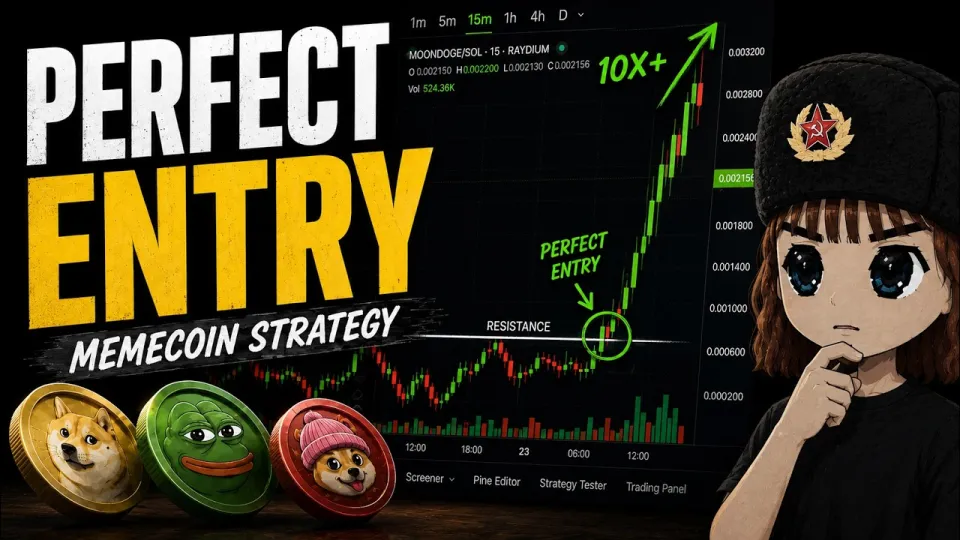
Video: How I Find the PERFECT Entry on Memecoins 📈 (Full Strategy)
You can order the same kind of articles for your own video to boost it on YouTube and Google. Just message the Telegram bot @sat_sit_bot. Articles with your video embedded are written and posted by the bot itself — on popular topical sites (no ads). Free trial — 50 articles.
Key takeaways
- Most meme coin losses come from timing, not token selection: the same coin can be a good trade or a bad one depending on where you enter.
- Entry quality is defined by the distance to invalidation: the tighter the stop below support, the better the risk-to-reward on the same setup.
- Momentum is confirmed by higher lows and expanding volume on the push, not by the size of a single green candle.
- Pullbacks into a broken resistance or the previous consolidation zone give better fills than market-buying a vertical candle.
- A pre-planned exit ladder and a hard invalidation level must exist before the buy button is pressed.
A meme coin is a highly volatile token with no cash flow, so its price is driven almost entirely by attention and liquidity — which is why entry timing matters more than the pick itself. The practical answer: wait for momentum to be confirmed by structure and volume, then buy the pullback into support with a defined invalidation level, instead of market-buying a vertical green candle. The full breakdown of this process comes from the starwifpump video «How I Find the PERFECT Entry on Memecoins», and the channel's tool stack and early-access links are collected in the Plasma Telegram channel.
Why the meme coin entry matters more than the pick
On a meme coin the difference between a good and a bad trade is usually the entry price, not the ticker. A token that runs 300% from launch can still destroy a trader who bought the top of the first impulse, because the retrace that follows a vertical move is often 40–60% and happens in minutes. The same token bought on a controlled pullback with a stop 8–12% below entry turns the identical chart into a completely different risk-to-reward profile.
This is the core argument of the starwifpump breakdown: most traders do not lose because they chose the wrong coin, they lose because they entered at the wrong time. Chasing a green candle means your invalidation level sits far away, so position size has to shrink to keep risk constant — and a small position with a wide stop rarely pays for the losses taken on the failed attempts.
The pre-entry checklist before you look at a chart
A repeatable meme coin strategy starts with filters that exist outside the price chart. Before any technical work, confirm the basics:
- Liquidity depth — check the pool size and whether a single sell of your intended position would move price by more than a few percent.
- Holder distribution — a token where a handful of wallets control a large share of supply can be dumped on you regardless of how clean the chart looks.
- Contract and socials — mint authority, freeze authority, tax settings, and whether the community channels are actually active rather than bot-filled.
- Narrative timing — is the token riding a fresh catalyst, or is it a two-week-old story that already had its run?
If any of these fail, the chart setup is irrelevant. A perfect entry on a token you cannot exit is still a losing trade.
How to read momentum without chasing the pump
Momentum on a meme coin chart is confirmed by structure and volume, not by the size of one candle. The signals that matter are higher lows on consecutive pushes, volume expanding on the upward leg and contracting on the pullbacks, and the price holding above the level that broke it out. A single parabolic candle with falling volume on the next push is exhaustion, not momentum.
The practical rule is to separate the impulse from the entry. When a token goes vertical, you do not buy the candle — you mark the base of the impulse, the consolidation that preceded it, and the first level the price broke. That marked zone becomes the area where you are willing to do business. This is the difference between reacting to price and anticipating a location.
Pullbacks, support and the setups worth waiting for
A high-quality meme coin entry is usually a pullback into a level that has already proven itself. Three setups repeat most often:
- Break-and-retest — price breaks a consolidation high, then returns to that high and holds it as support.
- Higher-low continuation — after an impulse, the price prints a higher low above the previous base, showing buyers defending a rising floor.
- Failed breakdown — price wicks below a support level and immediately reclaims it, trapping late sellers.
In each case the entry is placed at or just above the level, not in the middle of empty space. The invalidation sits below the structure that created the setup — below the retested high, below the higher low, or below the reclaimed support — and that distance defines your position size.
Red flags that tell you not to enter
Some charts should be skipped entirely, and recognising them saves more capital than any entry technique. Do not enter when volume is fading while price grinds higher, when the token has already printed three or more vertical legs without a meaningful pullback, or when the spread on the pair is wide enough that a market order fills far from the chart price. A sharp wick down that is immediately bought back is a warning about thin liquidity, not a discount. If the only reason to buy is that the chart is green and the timeline is loud, that is FOMO, and the correct action is to wait for the next setup rather than to size down and hope.
Planning risk, exits and profit-taking before the buy
Risk planning happens before the order, not after it. A workable template for a meme coin trade:
- Mark the invalidation level from the chart structure.
- Decide the maximum percentage of the account you are willing to lose on the trade — commonly a small single-digit share, given meme coin volatility.
- Calculate position size from that loss budget and the distance to invalidation.
- Pre-set the first profit-taking zone, usually at the prior high or the next round level, and sell a portion there.
- Move the stop to breakeven only after the first partial is filled, never before.
The goal is not to predict every move. It is to build a process that produces the same decisions whether the chart is pumping or dumping.
Common questions from newer meme coin traders
Beginners most often ask which filters to use in trackers and how to catch the social catalyst before the pump. The honest answer is that trackers surface candidates, but the entry decision still comes from the chart and from liquidity checks — a screener that shows a token early does not tell you where your stop belongs. Another recurring question is whether the same approach works on every chain; the mechanics of momentum, support and invalidation are universal, while liquidity depth, gas costs and terminal tooling differ between Solana, Ethereum and newer chains, so position sizing has to adapt. The most common doubt of all is capital: traders who lost money on impulse buys usually lost it to entries taken without a plan, not to the asset class itself, which is exactly why the process above starts with invalidation rather than with a target.
Useful links
- Plasma Telegram — early access, updates and setup help
- starwifpump Discord community
- Padre terminal VIP access
- Play Solpump
- starwifpump on X
- Axiom trading terminal early access
- GMGN VIP access
- Bloom Solana sniper bot
Bottom line
A meme coin entry is a location, not a feeling: momentum confirmed by structure and volume, a pullback into a level that already proved itself, and an invalidation close enough that the risk-to-reward works. Skipping the vertical candles and the thin-liquidity names is not missed opportunity — it is the part of the strategy that keeps the account alive long enough for the good setups to arrive. The starwifpump channel built this framework around one idea: the entry, not the ticker, decides the outcome of the trade. If you want the tooling and early access mentioned in the breakdown, start with the Plasma Telegram channel and paper-trade the setups before risking real capital.
Questions & answers
What is the best moment to enter a meme coin?
The best moment is a pullback into a level that already held — a retested breakout, a higher low, or a reclaimed support — with volume confirming the move. Buying a vertical green candle puts your invalidation far away and ruins the risk-to-reward before the trade even starts.
How do I avoid FOMO when a meme coin is pumping?
Decide your entry zone before the pump happens and treat a missed move as a non-event. If price is far from your level, the correct action is to wait for the next setup rather than to size down and chase, because a chase with a wide stop is the most common way accounts bleed out.
Do I need special tools to find meme coin entries?
A charting tool plus a liquidity and holder check covers most of the work; terminals and screeners help you find candidates faster but do not replace the entry decision. Tools mentioned in the starwifpump breakdown include trading terminals, sniper bots and a Telegram channel for early access.
Does the same entry strategy work on every chain?
The mechanics — momentum, support, invalidation, position sizing — are the same everywhere, but liquidity depth, gas costs and available tooling differ between chains. Adjust position size to the depth of the specific pool you are trading, not to a number copied from another chain.
Source: How I Find the PERFECT Entry on Memecoins 📈 (Full Strategy) · Markdown version